
Seed, mulch and soil prep for Greater Boston
Hydroseeding in Boston, MA
New lawns, raw construction lots and washing slopes, seeded for New England ground and a short fall window.
- No-charge yard visit and an itemized quote on paper
- Seed blends picked for sun, shade and salt exposure
- Watering and first-mow instructions with every job
What Hydroseeding Does on Boston Ground
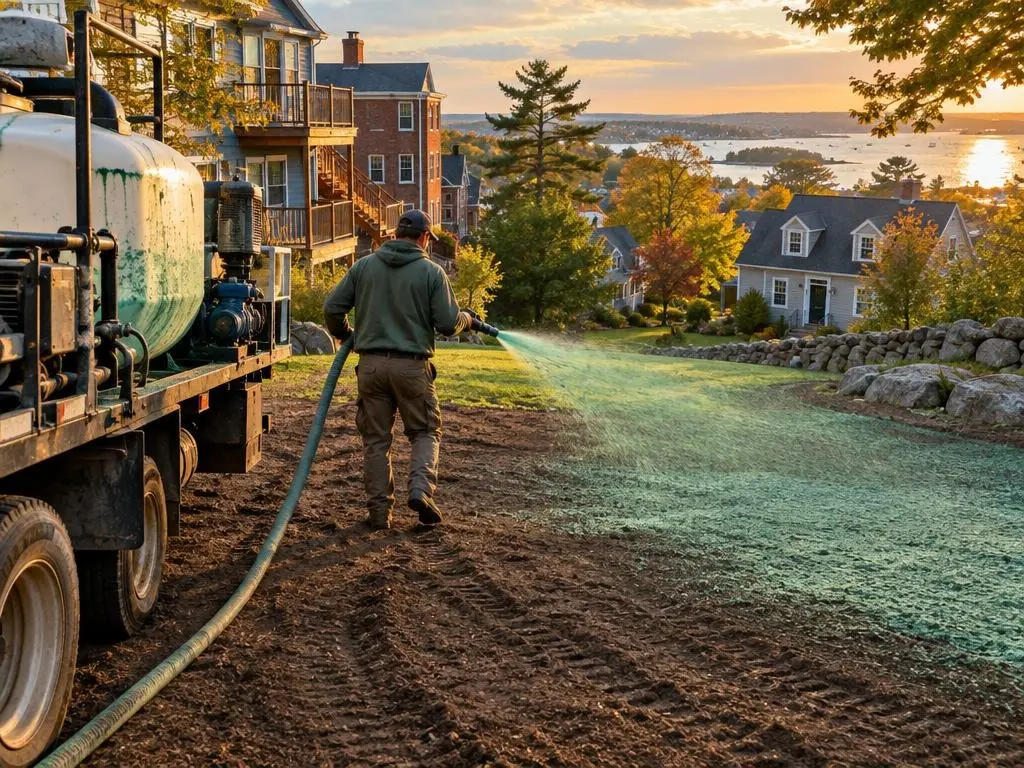
Hydroseeding in Boston means mixing grass seed, wood or paper hydromulch, fertilizer, a tackifier and water in a tank and spraying the slurry over prepared soil. Once sprayed, the fiber layer keeps the seedbed from drying out between waterings, and the tackifier binds that layer to the ground, so the seed stays put on a slope or in a downpour instead of washing into the street. We use it for new lawns behind rebuilt houses, bare ground after septic, drainage or foundation work, builder lots that need a stand of grass before a final inspection, and banks that will not hold soil on their own. This page explains how the ground, weather and seasons around Boston affect a hydroseed lawn, how hydro seeding compares with sod and dry seed, and how we run a job.
Two kinds of dirt under one city
Inside the city, much of the land is man-made. Wikipedia notes that more than two-thirds of inner Boston's modern land area did not exist when the city was founded; it was built up by filling marsh and tidal flats. On those lots the top foot or two can be old fill with brick, ash and gravel mixed in, and it dries out fast. Farther out, in towns like Newton, Lexington, Acton and Weston, the common soil is Paxton, which the USDA names as the Massachusetts state soil. Paxton forms in lodgment till on hills and drumlins. Its surface is a dark brown fine sandy loam, but somewhere between about 20 and 40 inches down it turns into dense till that slows water and roots. A new lawn on either ground needs real topsoil and decent grading before any seed goes down. When a yard here goes thin by its second summer, seed sprayed straight onto fill or packed subsoil is usually what we find underneath.
Weather that tests new seed
Boston averages about 43.6 inches of precipitation a year and about 49.2 inches of snow per season. The coast is very prone to nor'easters, and late spring often brings sea breezes that can keep waterfront neighborhoods much cooler than towns a few miles inland. For seeding, that means two things. First, a hard rain can hit fresh seed in any month, so the mulch layer and tackifier carry a lot of weight, and on slopes we may switch to a heavier bonded fiber matrix or erosion control blankets. Second, a yard in East Boston, Hull or Hingham does not behave like one in Framingham or Hopkinton. Salt spray and wind near the harbor favor tougher fescues; inland lawns in full sun can carry more Kentucky bluegrass.
When to seed around Boston
The grasses that do well in eastern Massachusetts are cool-season types: Kentucky bluegrass, perennial ryegrass, plus tall and fine fescues. They germinate fastest in warm soil with cool nights, which is why late August through September is our first choice for hydroseeding. The seedlings get six to eight weeks of growth before the average first freeze, which Boston records place around November 9, and they skip most of the weed pressure of spring. Spring seeding works too, once the ground has thawed and dried enough to grade, roughly after the average last freeze in early April. The catch is that spring grass has only a couple of months before July heat, so it needs steady watering. Midsummer seeding is possible with irrigation but costs more in water and attention. Seed sprayed after about mid-October often sits dormant until spring; we will tell you honestly if your timing is too late.
Sod vs hydroseed vs dry seed
All three can give you a good lawn; the difference is cost, speed and how the seed is protected.
- Sod gives a finished look the same week. It is also the most expensive per square foot, it is grown on whatever soil the sod farm has, and it needs heavy watering until the roots knit into the ground below.
- Dry seed spread by hand or broadcaster is the cheapest. Without a mulch layer, birds, wind and rain take a share, and on any slope a storm can move the seed to the bottom of the yard.
- Hydroseed sits in the middle on price. Its fiber blanket holds water around each seed and stops it drifting, the slurry reaches odd corners and slopes a sod roll will not, and you can pick a blend for sun, shade or salt instead of taking whatever sod is on the truck. Expect to see green in roughly one to two weeks and a first mow around four to six weeks.
For a large backyard, a slope, or a lot with tight access from the street, hydroseeding is usually the better value. For a small front strip you need finished before a closing, sod may make sense, and we will say so.
Erosion and sediment control comes with the job
Bare soil in a city full of catch basins does not stay in your yard for long. Many of our jobs include erosion control along with the seed: silt fence or compost sock on the low side of a site, inlet protection on nearby drains, erosion control blankets on steep banks, and hydromulch heavy enough to hold through a nor'easter. Builders and site contractors often need these in place before work starts, and we install them to the plan. On homeowner jobs we keep it simple and add only what the slope and drainage call for.
Grading, topsoil and repair work
A good lawn starts with the shape of the yard. Our crews handle the dirt work: rough and fine grading, yard grading to pitch water away from the house, spreading screened topsoil, and the excavation and trenching for a drain line when regrading alone will not move the water. We also do lawn repair and overseeding for tired lawns that do not need to be started from scratch, and lawn renovation when they do.
How a job runs
1. A free site visit to measure, test the soil depth and look at slope, sun and drainage. 2. A written estimate with prep, topsoil, seed blend, mulch and controls listed separately. 3. Prep day: debris out, grade set, topsoil spread and raked smooth. 4. Spray day: one tank mix carries the seed, mulch, fertilizer and tackifier onto the ground together, with blankets or silt controls where needed. 5. A written watering and first-mow plan, and a call to check on germination. Call (617) 812-0882 to set up a visit.
Why Homeowners Call Hydroseeding Boston
Soil before seed
We dig test holes and check topsoil depth on every job, because old fill and dense till are what make new lawns fail around here.
Blends for the exposure
Shade under old oaks, salt wind near the harbor and dry south-facing slopes each get their own cool-season mix.
Controls that fit the site
Silt sock, silt fence, inlet protection and blankets where the slope and drains call for them, not by default.
Itemized written estimates
Prep, topsoil, seed, mulch and controls are listed separately, and the written estimate is what you pay.
Towns We Seed Around Boston
We work in Boston itself, from Dorchester and Roslindale to West Roxbury and Hyde Park, and out through the suburbs inside and along I-495. West of the city, Newton, Wellesley, Needham, Weston and Natick have drumlin hills, rocky till and mature lots where additions and rebuilds leave bare yards behind. Lexington, Concord, Acton and Sudbury sit on former farmland, river meadows and larger lots, and Burlington, Andover and Framingham mix homes with office and commercial sites. To the southwest, Hopkinton, Franklin and Medfield are in the upper Charles River watershed, where new construction and wetland edges make sediment control a regular part of the work. South of the city, Milton, Quincy, Canton, Dedham and Sharon run from the Blue Hills down to rivers and ponds, and on the South Shore, Hingham and Duxbury bring salt air, sandy ground and marsh edges. Open any town below for the soil, slopes and local rules we plan around there.
- Hydroseeding in Boston, MA
- Hydroseeding in Newton, MA
- Hydroseeding in Wellesley, MA
- Hydroseeding in Needham, MA
- Hydroseeding in Lexington, MA
- Hydroseeding in Concord, MA
- Hydroseeding in Sudbury, MA
- Hydroseeding in Framingham, MA
- Hydroseeding in Natick, MA
- Hydroseeding in Weston, MA
- Hydroseeding in Hopkinton, MA
- Hydroseeding in Andover, MA
- Hydroseeding in Burlington, MA
- Hydroseeding in Hingham, MA
- Hydroseeding in Duxbury, MA
- Hydroseeding in Milton, MA
- Hydroseeding in Canton, MA
- Hydroseeding in Sharon, MA
- Hydroseeding in Franklin, MA
- Hydroseeding in Acton, MA
- Hydroseeding in Dedham, MA
- Hydroseeding in Medfield, MA
- Hydroseeding in Quincy, MA
Seeding and Site Work We Do
Six kinds of work, from a new hydroseed lawn behind a triple-decker to silt fence on a builder's lot.
New Lawn Hydroseeding
A full hydroseed lawn on bare or rebuilt ground, from soil prep to the first mow.
Learn more →Construction Site Hydroseeding
Seeding for builders, developers and property managers, from house lots to multi-acre sites.
Learn more →Erosion Control & Slope Seeding
For steep banks, drainage swales and roadside ditches: hydromulch, bonded fiber matrix, or blankets of straw or coir.
Learn more →Silt Fence & Inlet Protection
Silt fence installation, compost sock and storm drain inlet protection for construction sites.
Learn more →Topsoil, Grading & Dirt Work
Yard grading, topsoil, fine grading and the dirt work that comes before a good lawn.
Learn more →Lawn Repair & Overseeding
Overseeding, patch repair and lawn renovation for thin, worn or damaged lawns.
Learn more →
Common Questions
What is cheaper, sod or hydroseed?
Hydroseed, by a wide margin. HomeGuide lists hydroseeding at $0.12 to $0.35 for each square foot, against $1 to $4 per square foot for installed sod. Dry seed is cheaper still, but without mulch it is easier to lose to rain, birds and slopes.
How much does hydroseeding cost in Boston?
National guides put most residential jobs between about $0.07 and $0.35 per square foot. Seeding 5,000 square feet of lawn runs $1,000 to $1,750 in HomeGuide's numbers. Minimum job fees of $300 to $500 are common. Topsoil, grading and erosion controls are extra, and we quote those once we have walked your site.
What part of the year suits hydroseeding around Boston?
Late August through September, for the cool-season grasses that grow here. Spring after the ground thaws is the second choice. Seed sprayed after mid-October often waits until spring to come up.
How long until a hydroseed lawn can be mowed?
Germination usually starts in one to two weeks. Most lawns are ready for a first, high mow around four to six weeks, when the blades stand roughly four inches tall.
Do I need topsoil before hydroseeding?
On most Boston-area lots, yes. City yards often have fill with brick and ash in it, and suburban lots often have dense glacial till close to the surface after construction. We check depth with test holes and tell you how much, if any, you need.
What watering routine does fresh hydroseed need here?
Short, light sessions several times daily at the start, just enough that the mulch never dries out and never puddles. Once the grass fills in we move you to fewer, deeper waterings. You get a written schedule with the job.
Can hydroseed hold on a steep bank?
With the right mix, yes. On steep slopes we add extra tackifier, or switch to bonded fiber matrix or blankets staked over the seed, which keeps it from sliding until the roots can anchor the soil.
Book a Free Look at Your Yard
Describe the yard or site as it stands today. We will come measure, check the soil and put a price in writing.